Rabies vaccine manufacturing requires highly controlled preservation processes because biological formulations can be sensitive to temperature, moisture, and processing conditions. Freeze drying provides a practical approach for converting carefully prepared vaccine formulations into a stable dried state while helping maintain their intended biological characteristics. As vaccine development and production become more sophisticated, manufacturers are placing greater emphasis on precise process control, reliable equipment, and consistent product quality.
A Freeze Dryer for Rabies Vaccine is designed around the specific requirements of pharmaceutical lyophilization. Rather than simply removing moisture, the process involves carefully coordinated freezing, primary drying, and secondary drying stages. Each stage can influence the final cake structure, residual moisture, reconstitution behavior, and overall stability of the finished vaccine.
For pharmaceutical manufacturers, the equipment therefore needs to provide controlled temperature and vacuum conditions, repeatable process performance, hygienic construction, and appropriate automation. These capabilities are becoming increasingly important as vaccine production moves toward more standardized and quality-focused manufacturing environments.
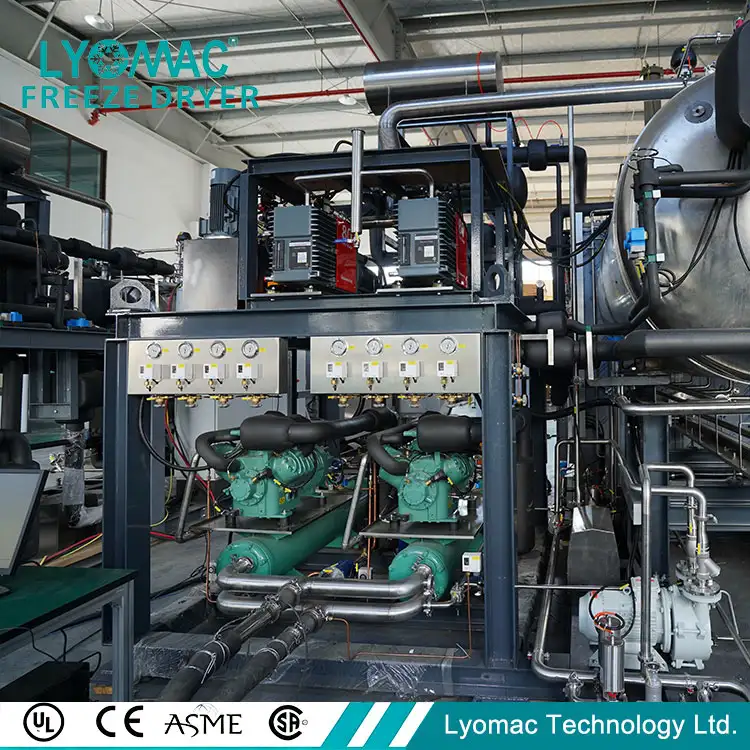
Rabies vaccines are biological products that require careful handling throughout manufacturing and storage. Their formulation characteristics can make conventional drying approaches unsuitable because excessive thermal exposure or uncontrolled moisture removal may affect product quality.
Lyophilization removes water from a frozen formulation through sublimation under vacuum. Because the material remains at a carefully controlled low temperature during critical stages, the process can reduce exposure to conditions that may be harmful to sensitive biological components.
The objective is not simply to produce a dry material. A successful cycle should create a stable product structure that can be reconstituted efficiently while maintaining the desired quality attributes. This requires accurate control of shelf temperature, chamber pressure, product temperature, and drying time.
Moisture can influence the stability of biological formulations during storage. Excessive residual moisture may contribute to unwanted physical or chemical changes, while overly aggressive drying conditions can also affect the final product structure.
Controlled lyophilization allows manufacturers to establish an appropriate balance between drying efficiency and product protection. Properly developed cycles can contribute to improved storage stability and more predictable reconstitution performance.
| Processing Stage | Primary Objective | Quality Consideration |
|---|---|---|
| Freezing | Establish a suitable frozen structure | Uniform product solidification |
| Primary drying | Remove ice through sublimation | Controlled product temperature |
| Secondary drying | Reduce remaining bound moisture | Appropriate residual moisture |
| Reconstitution | Restore the prepared formulation | Consistent dissolution behavior |
Freeze drying is a highly sensitive process in which changes in temperature, pressure, product formulation, or equipment conditions can influence the final result. For this reason, modern pharmaceutical systems place strong emphasis on process monitoring and accurate control.
Shelf temperature has a direct relationship with heat transfer and product temperature during drying. If the product becomes excessively warm during primary drying, its structure may be compromised. If the process is too conservative, drying may become unnecessarily slow and reduce manufacturing efficiency.
A well-engineered system provides stable shelf temperature control and effective heat transfer throughout the cycle. This gives process development teams a more reliable foundation for establishing repeatable operating conditions.
Chamber pressure is another critical parameter in pharmaceutical freeze drying. Stable vacuum conditions help maintain the sublimation environment required for controlled moisture removal.
Advanced equipment can integrate multiple pressure measurement technologies to provide a more complete understanding of chamber conditions. Reliable monitoring supports process development, troubleshooting, and production control while helping operators identify changes that may influence drying performance.
Monitoring product temperature provides valuable information about the actual state of the material during the drying cycle. This can help engineers understand the relationship between shelf temperature, chamber pressure, heat transfer, and sublimation behavior.
More precise process visibility can support better cycle development and reduce unnecessary trial and error. It also provides useful information for technology transfer from development environments to larger manufacturing systems.
The performance of a lyophilization system depends on more than its refrigeration and vacuum capabilities. Chamber construction, shelf design, sealing systems, control architecture, loading methods, and cleaning considerations all contribute to overall equipment performance.
Efficient and uniform heat transfer is essential for maintaining consistent drying conditions across the product load. Uneven heat distribution may result in different drying rates between locations within the chamber.
The equipment adopts optimized shelf conductive heating, combined with balanced radiation-assisted heat transfer, providing excellent temperature uniformity, avoiding localized overheating, protecting heat-sensitive materials such as peptides, biologic formulations, and APIs.
This approach is particularly relevant to pharmaceutical applications where process uniformity and protection of sensitive formulations are important considerations.
Pharmaceutical manufacturing environments require equipment designs that support stringent hygiene and contamination-control practices. Internal surfaces, seals, valves, and product-contact areas must be considered carefully during system engineering.
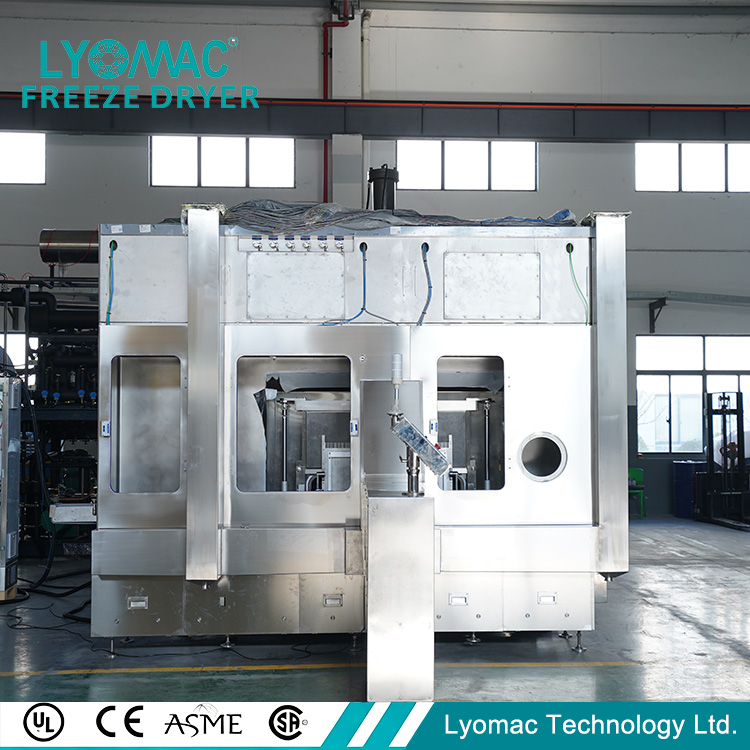
For aseptic applications, equipment configuration should also support appropriate loading, unloading, cleaning, and sterilization strategies. Trayless tilting shelf technology can provide an alternative approach for applications where product handling and aseptic transfer requirements demand specialized equipment design.
Manual product handling can introduce operational variation and increase the complexity of pharmaceutical production. Automated loading systems can help create a more controlled workflow by coordinating product movement between process areas.
Automation can also improve repeatability and reduce unnecessary operator intervention. When integrated with the freeze dryer control system, automated loading technologies can contribute to a more consistent manufacturing process.
Vaccine manufacturing does not begin with full-scale production. Formulations and drying cycles typically require development, optimization, characterization, and transfer before they can be implemented in a commercial environment.
Laboratory freeze dryers provide an environment for researchers and process engineers to investigate formulation behavior and develop initial drying cycles. Small-scale studies can help identify appropriate freezing conditions, drying parameters, and reconstitution characteristics.
Process development at this stage should focus on understanding the product rather than simply shortening the cycle. Data collected during development can provide a foundation for later scale-up activities.
Pilot systems provide an important bridge between laboratory development and commercial manufacturing. They allow engineers to evaluate how changes in chamber dimensions, shelf loading, heat transfer, and equipment configuration influence the established process.
A scalable equipment platform can simplify this transition by maintaining consistent engineering principles across different system sizes. This approach can reduce the challenges associated with transferring a process from development to production.
Commercial manufacturing requires stable equipment performance, robust automation, reliable maintenance, and comprehensive process documentation. Production systems must be designed around the facility environment and the operational requirements of the finished product.
A Freeze Dryer for Rabies Vaccine should therefore be considered as part of a complete manufacturing process rather than as an isolated machine. Refrigeration, vacuum, control systems, loading equipment, clean utilities, and facility interfaces all need to work together effectively.
Quality assurance is an integral part of pharmaceutical freeze drying. Equipment performance needs to be supported by appropriate design practices, manufacturing controls, documentation, and validation strategies.
Precision manufacturing helps ensure that critical components perform consistently over the operating life of the system. Advanced quality control instruments can be used during manufacturing and inspection to verify dimensional accuracy, component quality, and system integrity.
Reliable equipment construction also contributes to predictable maintenance requirements. For pharmaceutical facilities, long-term reliability can be as important as initial equipment performance because unexpected downtime can disrupt carefully scheduled production activities.
Pharmaceutical equipment may need to operate within environments governed by strict regulatory expectations. Engineering decisions should therefore consider documentation, traceability, control-system architecture, material selection, and validation requirements from the beginning of a project.
Systems designed with international pharmaceutical practices in mind can provide a stronger foundation for qualification and regulatory review. Compliance should be considered throughout the project lifecycle rather than treated as a final-stage requirement.
The development of vaccine manufacturing technology is increasingly influenced by automation, process analytical technology, digital monitoring, and flexible production strategies. These trends are changing how pharmaceutical companies approach freeze drying process development and equipment selection.
Process analytical technology can provide manufacturers with more information about critical process conditions during drying. Instead of relying only on predefined cycle settings, process engineers can use real-time information to better understand process behavior.
Dual vacuum measurement using Pirani and capacitance manometer technologies can provide complementary information about chamber conditions. When combined with appropriate process monitoring strategies, these technologies can support more informed process development and control.
Vaccine development programs can change as formulations, production requirements, and manufacturing strategies evolve. Equipment with flexible configurations can help facilities respond to changing process needs without requiring a complete redesign of the production system.
Scalable lyophilization platforms can also support a structured development path from laboratory studies to pilot verification and industrial manufacturing. Maintaining comparable process principles across stages can simplify technology transfer and improve engineering consistency.
Future pharmaceutical production environments are expected to rely increasingly on connected equipment and automated workflows. Freeze dryers can become part of larger manufacturing systems that coordinate material handling, process monitoring, data management, and quality activities.
This integration can help manufacturers build more transparent and controllable production environments. It also creates opportunities for better process analysis and more efficient use of engineering resources.
Selecting suitable equipment requires a detailed understanding of the product, process, facility, and future manufacturing objectives. A technically advanced system is most valuable when its configuration is aligned with the actual production requirements.
Evaluating these factors together can help pharmaceutical manufacturers select a system that supports both current production requirements and future process development. Equipment selection should ultimately be based on process suitability, engineering quality, regulatory expectations, and long-term service capability.
LYOMAC is a recognized supplier of lyophilizers, automated loading systems, and comprehensive technical services for pharmaceutical and biopharmaceutical applications. The company combines freeze drying engineering with automation capabilities to provide integrated solutions for demanding manufacturing environments.
Its systems are developed with attention to process control, manufacturing precision, and international pharmaceutical requirements. LYOMAC supports projects designed around cGMP, GAMP® 5, and FDA-regulated environments, while certifications such as UL, CE, ASME, and CSA help address different technical and regulatory requirements.
LYOMAC also provides technical support and maintenance through its worldwide service network. Its experienced engineering team focuses on customized solutions rather than relying on a single equipment configuration for every application.
For pharmaceutical manufacturers developing or expanding vaccine production capabilities, choosing an experienced equipment partner can make a meaningful difference in process reliability, technology transfer, and long-term system performance. With advanced manufacturing facilities, quality control capabilities, automation expertise, and continued investment in freeze drying technology, LYOMAC is positioned to support demanding pharmaceutical and biological applications with reliable and precisely engineered solutions.