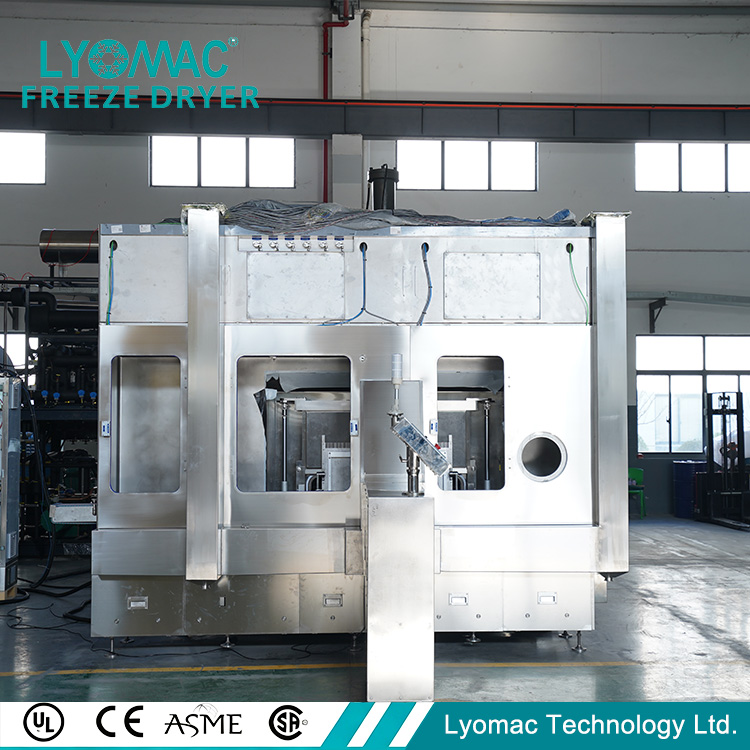
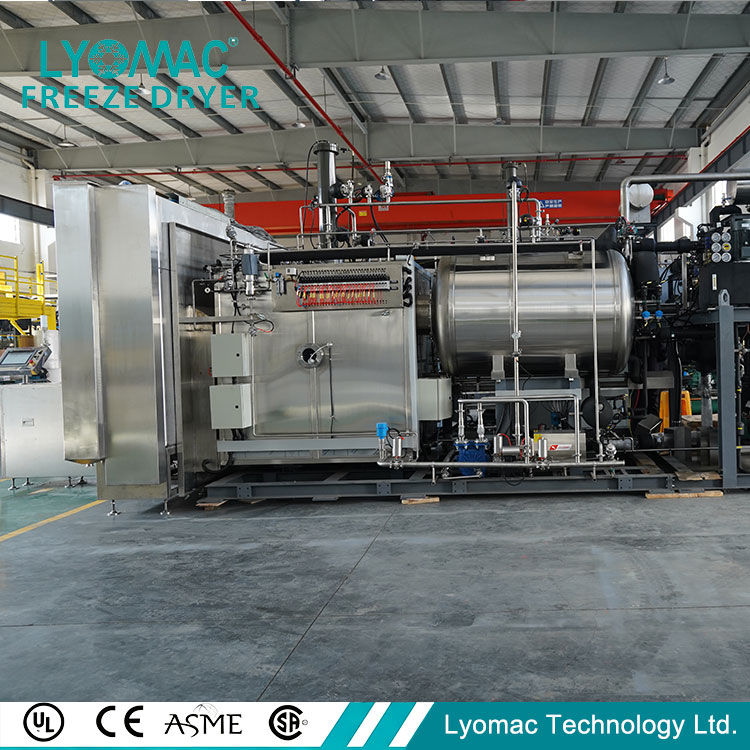
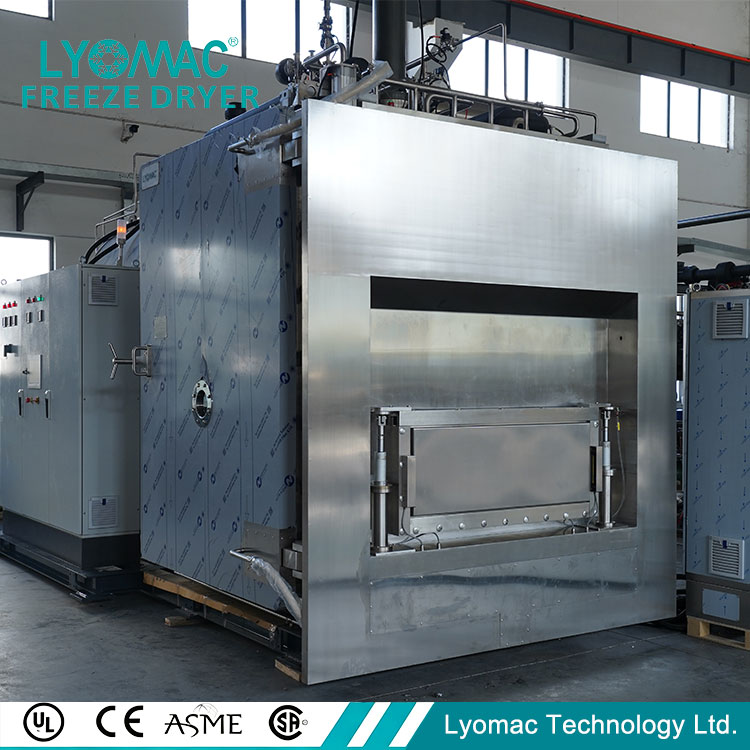
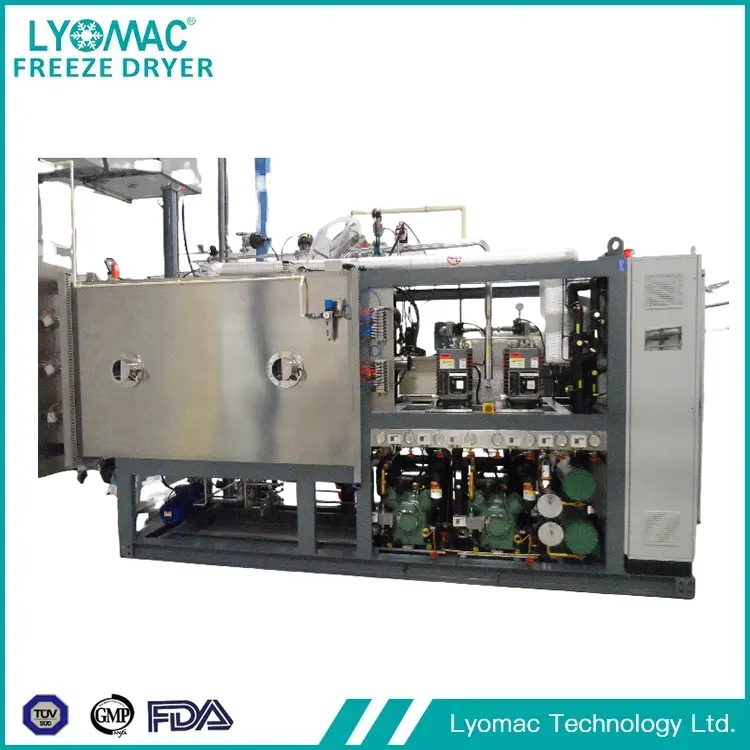
Technology and Application Analysis In the industrial production field, industrial freeze dryers, with their unique low-temperature drying advantages, have become indispensable core equipment in many industries such as pharmaceuticals, food, bioengineering, and new materials. Compared with household freeze dryers, industrial freeze dryers have larger processing capacity, more precise process control, and more complex system design, meeting the stringent requirements of large-scale industrial production for product quality, stability, and efficiency.
I. Core Technologies and Working System of Industrial Freeze Dryers
The working principle of industrial freeze dryers is based on three core steps: "freezing - sublimation - desorption." Its core technology lies in the precise control of temperature, vacuum level, and time. The entire system consists of four main systems: a refrigeration system rapidly freezes materials to a set low temperature (typically -40°C to 80°C), employing cascade refrigeration technology to ensure low-temperature stability; a vacuum system creates a high-vacuum environment (pressure below 100Pa) using a vacuum pump group, providing the necessary conditions for ice sublimation, and is equipped with vacuum measurement and control devices to adjust the vacuum level in real time; a heating system uses radiant or conductive heating to provide energy for the sublimation process, preventing excessively high material temperatures that could damage nutrients or active ingredients; and a water-capturing system uses a low-temperature water trap (temperatures as low as -60°C to 120°C) to capture water vapor generated during sublimation, preventing moisture backflow and affecting the drying effect.
Modern industrial freeze dryers also incorporate intelligent control technology, using a PLC control system to achieve precise setting, real-time monitoring, and data recording of process parameters. This supports process reproducibility across multiple batches and includes safety functions such as fault alarms and automatic shutdown, significantly improving production stability and reliability. Some high-end equipment is also equipped with Clean In-Place (CIP) and Sterilization In-Place (SIP) systems to meet the clean production requirements of industries such as pharmaceuticals and food.
II. Main Application Areas of Industrial Freeze Dryers
Pharmaceutical Industry: This is one of the core application areas of industrial freeze dryers. Heat-sensitive drugs such as antibiotics, vaccines, biological products, and protein drugs are prone to degradation and inactivation during room temperature or high temperature drying processes. Freeze drying technology can remove moisture in a low-temperature vacuum environment, preserving the active ingredients and efficacy of the drugs. Freeze-dried drugs have strong stability, a shelf life that can be extended to several years, and can quickly restore their original efficacy after rehydration. They are widely used in the production of injectable drugs, oral preparations, and other products.
Food Industry: Industrial freeze dryers are used for large-scale production of freeze-dried foods, such as freeze-dried fruits and vegetables, freeze-dried meats, and freeze-dried convenience foods. Compared with household equipment, industrial models can achieve continuous production, with a daily processing capacity of several tons or even tens of tons. For example, freeze-dried coffee retains the aroma and flavor of coffee through freeze-drying technology, and its taste is close to that of freshly ground coffee after brewing. Freeze-dried instant porridge, freeze-dried noodles, and other convenience foods only require hot water to prepare, preserving the nutrients of the ingredients while achieving long-term storage at room temperature, meeting the demands of the fast-moving consumer goods market.
In the field of bioengineering: it is used for the drying and preservation of microbial preparations, enzyme preparations, cell products, etc. For example, in industrial production, probiotic preparations, after moisture removal through freeze-drying, allow the probiotics to maintain their activity in a low-temperature drying environment. The resulting probiotic powders and capsules have long shelf lives and can quickly recover in the intestines after consumption. Enzyme preparations, after freeze-drying, exhibit significantly improved stability, facilitating transportation and storage, and are widely used in food processing, wastewater treatment, and other industries.
In new materials and other fields: In the field of new materials, industrial freeze dryers are used for drying nanomaterials, porous materials, superconducting materials, etc., preventing agglomeration and structural damage during the drying process and preserving their unique physicochemical properties. In fields such as cultural relic restoration and aerospace, freeze-drying technology can be used to treat damp cultural relics and space food, enabling long-term preservation or applications under special conditions.
III. Industry Development Trends
As industries increasingly demand higher product quality, industrial freeze dryers are evolving towards greater efficiency, energy conservation, and intelligence. On one hand, optimizing the design of refrigeration and vacuum systems improves energy utilization efficiency and reduces equipment operating energy consumption. On the other hand, integrating AI algorithms and IoT technologies enables remote monitoring, fault prediction, and process optimization, further enhancing production efficiency and product consistency. Simultaneously, customized freeze-drying equipment is becoming a development hotspot, catering to the individual needs of different industries. Examples include aseptic freeze dryers for biological products and continuous freeze-drying production lines for the food industry, better meeting the segmented needs of various sectors.
As a high-end, interdisciplinary piece of equipment, the technological development and application expansion of industrial freeze dryers not only drive the transformation and upgrading of related industries but also provide crucial support for people's healthy lives and technological progress. In the future, they will continue to play a key role in many emerging fields.